The 07:00 Gamble: Is Ouarzazate Worth One Day?
Eight hours of mountain road for one perfect fortress: here is the honest math. It starts with the photos: red mudbrick towers against snow-dusted Atlas, the kind that stop your scrolling. Then comes the itinerary fine print: 07:00 pickup, return near 19:30, most of the middle spent climbing and descending the same pass twice.
We run this road weekly, so no sales pitch: the ksar repays the drive, the drive demands respect, and the verdict section below tells you exactly who should go and who should take the 3-day loop instead.
The day at a glance
- 07:00 hotel pickup in Marrakech, return 19:00–19:30
- ~200 km / 3.5–4 hrs each way via the N9 and the Tizi n'Tichka pass (2,260m)
- Ksar Aït Ben Haddou climb, Taourirt Kasbah, Atlas Film Studios sets
- 100% private: stops on demand, air conditioning that works, driver who knows every viewpoint
Who this day is built for
- First-time Morocco visitors with no spare night and one non-negotiable fortress
- Film-location pilgrims: four productions, two studios, one backlot, zero CGI
- Photographers chasing red clay against snow-line Atlas: winter mornings deliver both
Shared-bus versions of this day exist and they run on other people's bladder schedules. Private means the driver stops when the light does.
Energy budget, honestly stated: two strong viewpoint hours before lunch, a slower hot afternoon, and a golden final descent. If that rhythm sounds like your kind of day, book it. Bring curiosity and a charged camera: the pass handles the rest.
Crossing the Tizi n'Tichka Before the Buses
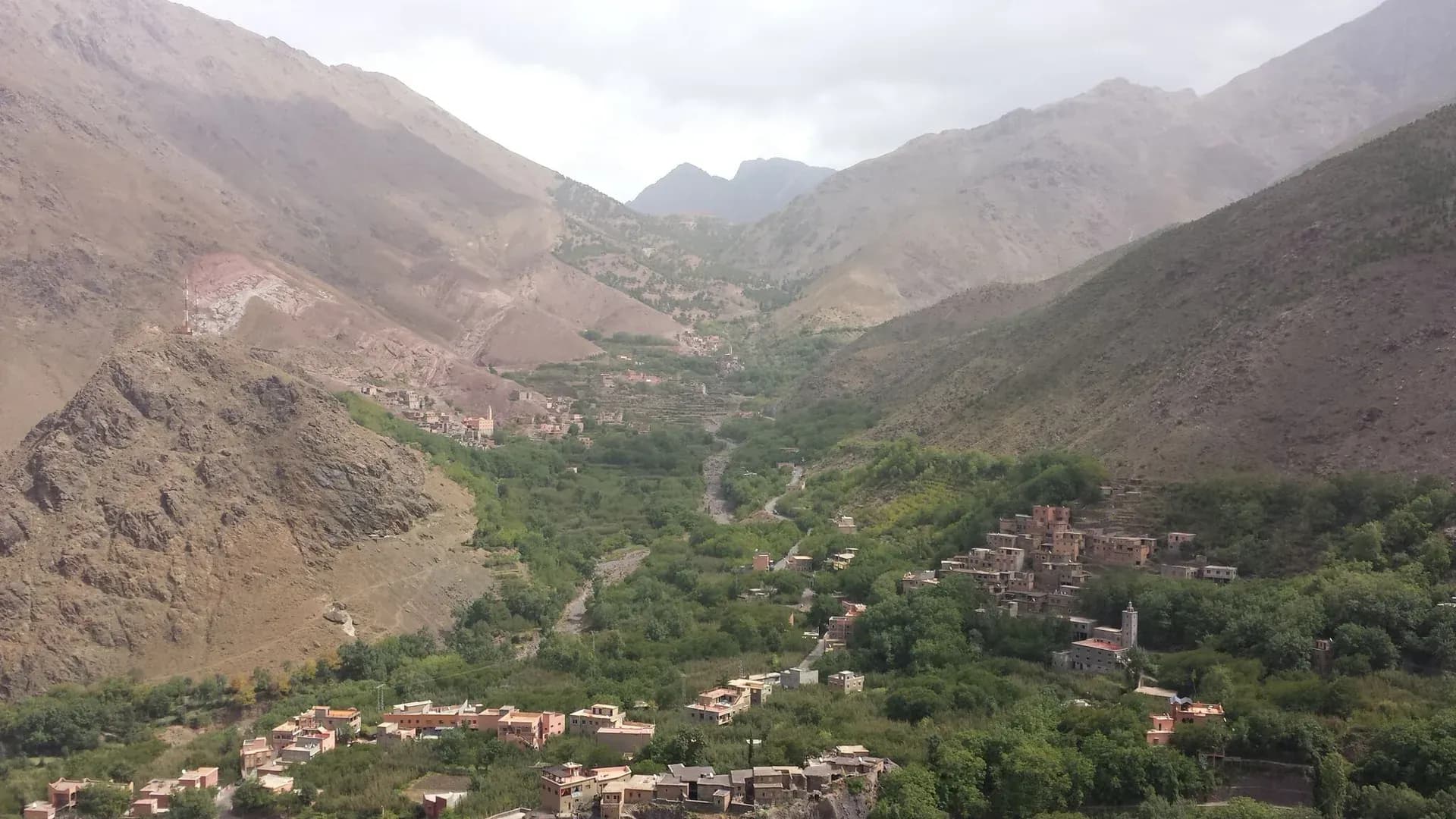
The pass is the first sight, not the obstacle. Route N9 leaves the Haouz plains and starts stacking switchbacks almost immediately. Our first leg-stretcher is a Berber village stop, Ait Ben Barka and its neighbors, where rural Atlas life runs at donkey pace and the terraced fields drop into the valley.
By mid-morning you're at the 2,260-meter summit viewpoint, the highest major paved pass in North Africa, looking down the serpentine descent you are about to drive. Winter travelers get a bonus shock: snow, real snow, an hour from palm trees. Roadside stalls sell amethyst geodes and fossil slabs along the whole climb: browse freely, buy in Rissani if at all, where the same stones cost half.
The descent drops through juniper forest into red-earth villages stacked up impossible slopes. Every hairpin has a viewpoint and our drivers know which three are worth the brake pedal.
Pass rules
- Layers live in the daypack, not the trunk: the summit runs 10–15 degrees cooler than Marrakech, year-round
- Front seats for the motion-sensitive: the descent is 100+ curves of pure switchback
- The early start isn't cruelty, it's strategy: you cross before the tour-bus convoys and reach the ksar before the heat
Ksar Aït Ben Haddou: Climb It Properly
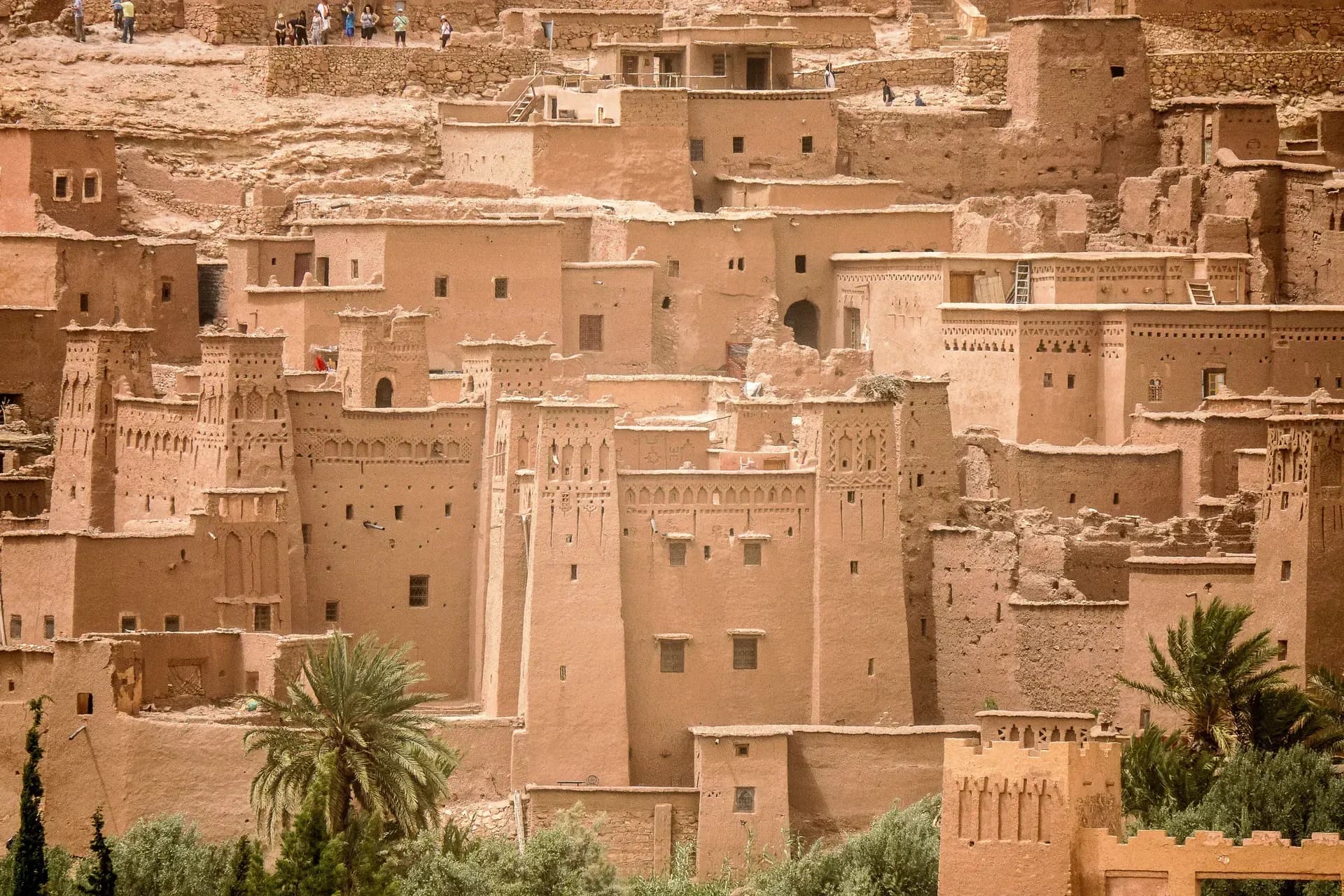
The most photographed mudbrick in Morocco deserves every pixel. Ouarzazate (say war-zazat) calls itself the Door of the Desert: past it, the Sahara spreads 9 million square kilometers. But the fortress 30 km before town is the reason you came: a UNESCO-listed ksar raised over centuries of trans-Saharan caravan traffic, sitting improbably green in its palm valley.
Hollywood keeps paying the location fee for a reason: Lawrence of Arabia, The Mummy, Gladiator and Game of Thrones all shot these lanes. You will walk streets where film crews still leave faux-Egyptian facades standing between real family homes.
The climb, step by step
- Cross on foot from the new village side: the riverbed route, not the bridge, when water is low
- Climb the mudbrick lanes to the hilltop granary for the 360-degree oasis view; allow 2 unhurried hours
- Entry to the ksar is free; licensed local guides wait at the crossing and work for tips: take one for the hidden mosque and old oil press
- Lunch on a terrace facing the walls: slow tagine, fast view
The ksar behind the postcard
- Most families moved across the river to the new village decades ago: the old ksar holds a handful of residents, artists' studios and guesthouses
- The hilltop agadir was the community vault: grain, valuables and manuscripts behind collective walls, defended by position alone
- Painters and weavers work in the lanes; the carpet cooperatives here unroll without pressure, a low-key rehearsal for Marrakech souks
- The green paradox is literal: the Ounila river keeps palms and barley alive at the foot of sun-baked pisé: photograph it from the granary, not the parking lot
- Tempted to stay? Ksar-side guesthouses put sunrise over the walls outside your window: the standard first night of every 3-day loop for exactly this reason
Be inside the walls before 10:30: granary light is golden and the day-trip crowds are still on the pass.
Taourirt Kasbah and the Film Studios
Ouarzazate town itself is a working desert town, not the attraction: the kasbah and the studios are. Adjust expectations accordingly and you'll love both.
Taourirt was the palace-fortress of the Glaoui clan who ruled the south: a maze of staircases, shaded courtyards and some of Morocco's best-preserved painted plaster and cedar ceilings. Thami El Glaoui, Pasha of Marrakech from 1912 to 1956 and once among the country's most powerful men, received French generals and foreign dignitaries in these very rooms. One unhurried hour, preferably before the afternoon heat pools in the courtyards.
On the backlot
- Atlas Film Studios ranks among the largest studio complexes in Africa: Egyptian temples and Tibetan monasteries share one dusty backlot
- You walk the sets freely: linger on the Gladiator streets, glance into the rest
- Props, half-built facades and painted horizons everywhere: the most honest look at movie magic in Morocco
- Allow one hour; the on-site museum fills the gaps between the facades
- Visits run as guided rounds, not free wandering: the guides are studio crew and the anecdotes are first-hand
- Lunch is in town between the two: tagines built for hungry drivers, couscous on the right day
Kasbah first, studios second: the kasbah's thick walls are the coolest rooms in Ouarzazate after 14:00.
Worth It? The Honest Math
No version of this day involves less than 8 hours in a car. The Tizi n'Tichka winds both ways, the curves punish the motion-sensitive, and even road-trip lovers feel the last hour. Say it plainly: this is a lot of traveling for one day.
So who takes it? First-time Morocco visitors with no spare night, film-location pilgrims, and anyone for whom the ksar is a non-negotiable. The views genuinely carry the hours (Atlas, Ounila Valley, ksar, studios) and a private driver (stops on demand, no bus schedule tyranny) halves the pain of the public-transport alternative.
Motion-sensitive? Say so at booking: front seat, extra summit stops and ginger tea at every terrace: the pass is entirely manageable with the right seat and pace.
The upgrade path is genuine, though. Our 3-day Merzouga loop covers the same ksar without the same-day return drive, then keeps going to Todra Gorge and a luxury Erg Chebbi camp. Same fortress, one-third of the Day-1 driving, plus dunes. If your calendar has 3 days, take them. Stuck at 2? The Zagora overnight breaks the drive with a desert sunset: smaller dunes, honest trade, half the road back.
Packing, Roads and Getting There
Departures leave at 07:00: non-negotiable if you want the ksar before crowds and heat. Private 4x4 or minivan, dedicated chauffeur, fuel and door-to-door pickup are in our format; the day ends where it started, at your riad door.
Packing list
- Broken-in walking shoes: ksar lanes are uneven mudbrick and the granary climb is steep
- Sunglasses and sun hat: the light bounces off clay and sand alike, even in winter
- A warm layer: the pass is cold mornings and winters bring real snow
- Loose, shoulder-covering clothing: respectful and cooler than shorts
- Small backpack with water; refill at lunch
- French and Arabic open every door; your driver translates the rest: English everywhere on the tourist circuit, smiles everywhere off it
The three ways down
- Private driver: stops where you point, AC that works, zero schedule math: the format this guide assumes
- Rental car: the N9 is paved and fine, but the pass rewards mountain-driving experience and Marrakech exits are chaotic
- Bus: 4.5 hours each way on fixed departures: cheapest, and the quickest way to turn 8 driving hours into 10
- Winter self-drivers: the pass can ice overnight: cross after 09:00 and never at night, or hand the keys to a driver and watch the snow instead
Booking notes
- Dates shift free of charge up to 48 hours before departure
- Tell us dietary needs when booking: vegetarian and gluten-free tagines are standard, not a favor
更多旅游指南与游记
常见问题
瓦尔扎扎特(Ouarzazate)的一日游值得长途驱车前往吗?
是的,如果你想去艾特·本·哈杜(Aït Ben Haddou)和摩洛哥电影制片厂的话——但单程就要穿越蒂齐·恩·蒂奇卡(Tizi n'Tichka)山口,路程超过200公里。这绝对是一整天的行程;不适合容易晕车的游客。
从马拉喀什(Marrakech)到瓦尔扎扎特(Ouarzazate)开车需要多长时间?
经蒂齐·恩·蒂奇卡山口(Tizi n'Tichka,海拔2,260米)穿越高阿特拉斯山脉,单程约需4小时——沿途风景壮丽,但道路蜿蜒曲折。在瓦尔扎扎特(Ouarzazate)过夜是更为舒适的选择。
艾特·本·哈杜(Aït Ben Haddou)可以免费参观吗?
在卡斯尔内自由漫步无需门票;当地向导会提供付费导览服务,费用不高。部分民居会收取10至20摩洛哥迪拉姆的入场费,供游客攀登至粮仓观景台。
哪些电影是在瓦尔扎扎特(Ouarzazate)拍摄的?
《角斗士》、《权力的游戏》(Aït Ben Haddou 拍摄的“渊凯”场景)、《阿拉伯的劳伦斯》、《木乃伊》等众多影片——阿特拉斯影城是非洲最大的电影制片厂群。
参加私人游览,探访这些景点
在我们的专业持证司机的陪同下,乘坐100%专属的空调车辆,享受从酒店门到门的接送服务,带您游览本指南中介绍的各处地标。
3天马拉喀什(Marrakech)至梅尔祖卡(Merzouga)沙漠之旅:埃尔格·切比(Erg Chebbi)豪华营地与骑骆驼之旅
高阿特拉斯山脉(2,260 米 / 7,415 英尺)· 联合国教科文组织世界遗产艾特·本·哈杜古城(Ksar Aït Ben Haddou)· 达德斯河与托德拉峡谷 · 埃尔格·切比(Erg Chebbi)豪华露营地 · 德拉河谷环线
4天马拉喀什(Marrakech)至梅尔祖卡(Merzouga)沙漠之旅:埃尔格·切比(Erg Chebbi)豪华营地与骑骆驼之旅
悠闲的4天撒哈拉环线之旅 · 高阿特拉斯山脉 · 艾特·本·哈杜古城(Ksar Aït Ben Haddou) · 托德拉峡谷(Todra Gorge) · 埃尔格·切比(Erg Chebbi)豪华营地 · 哈姆利亚(Khamlia)的格纳瓦音乐与游牧民族 · 德拉河谷(Draa Valley)与瓦尔扎扎特(Ouarzazate)